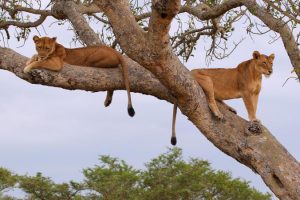
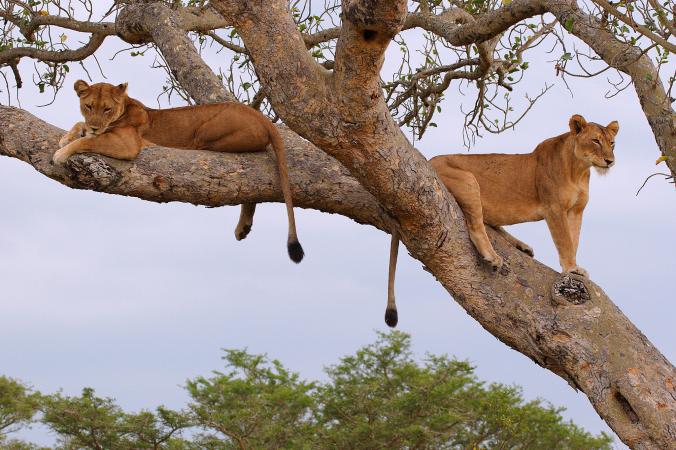
Most lions rule the savannah from the ground. In Ishasha, the southern sector of Uganda’s Queen Elizabeth National Park, they reign from the treetops.
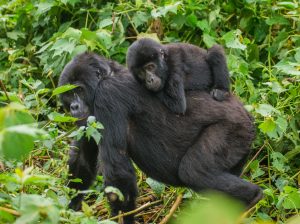
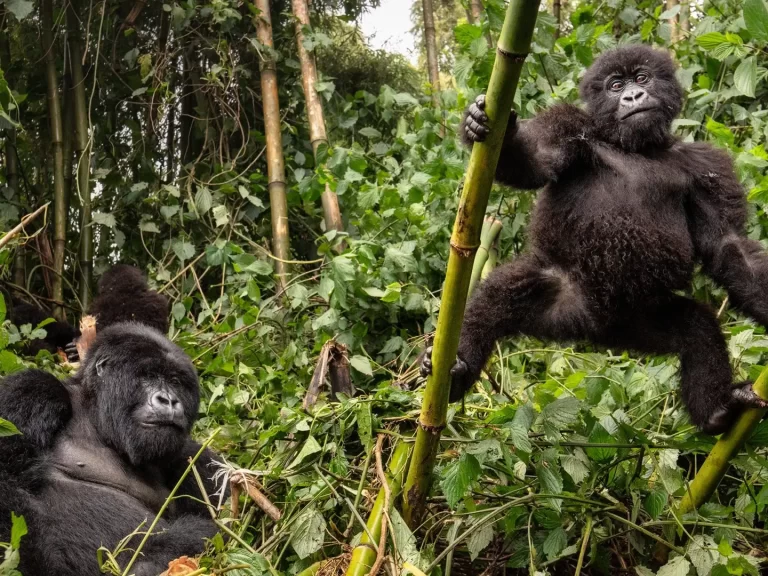
When travelers think of Uganda safaris, gorilla trekking in Bwindi Impenetrable Forest often steals the spotlight. Yet tucked away in the southern reaches of Queen Elizabeth National Park lies a wildlife phenomenon so rare it feels almost mythical: lions that climb trees.
The tree-climbing lions of Ishasha are among the most extraordinary sights on the African continent. For the fortunate safari-goers who find them sprawled across the broad branches of ancient fig trees, it is a moment that simply cannot be unseen.
About Ishasha and Queen Elizabeth National Park
Queen Elizabeth National Park is Uganda’s second-largest national park, covering approximately 1,978 square kilometres and straddling the equator in the western part of the country. It is one of Africa’s most biodiverse parks, home to over 600 bird species and 95 mammal species.
The Ishasha sector occupies the park’s remote southern corner, bordering the Democratic Republic of Congo along the Ishasha River. It is a strikingly different landscape from the park’s busier northern circuits: a sweeping patchwork of open savannah grassland, riverine forest, and clusters of towering sycamore fig and acacia trees that feel sculpted for drama.
It is in this quiet, untouched corner of Uganda that the tree-climbing lion behaviour has become a defining and legendary feature of the local lion prides.
Why Do Lions Climb Trees in Ishasha?
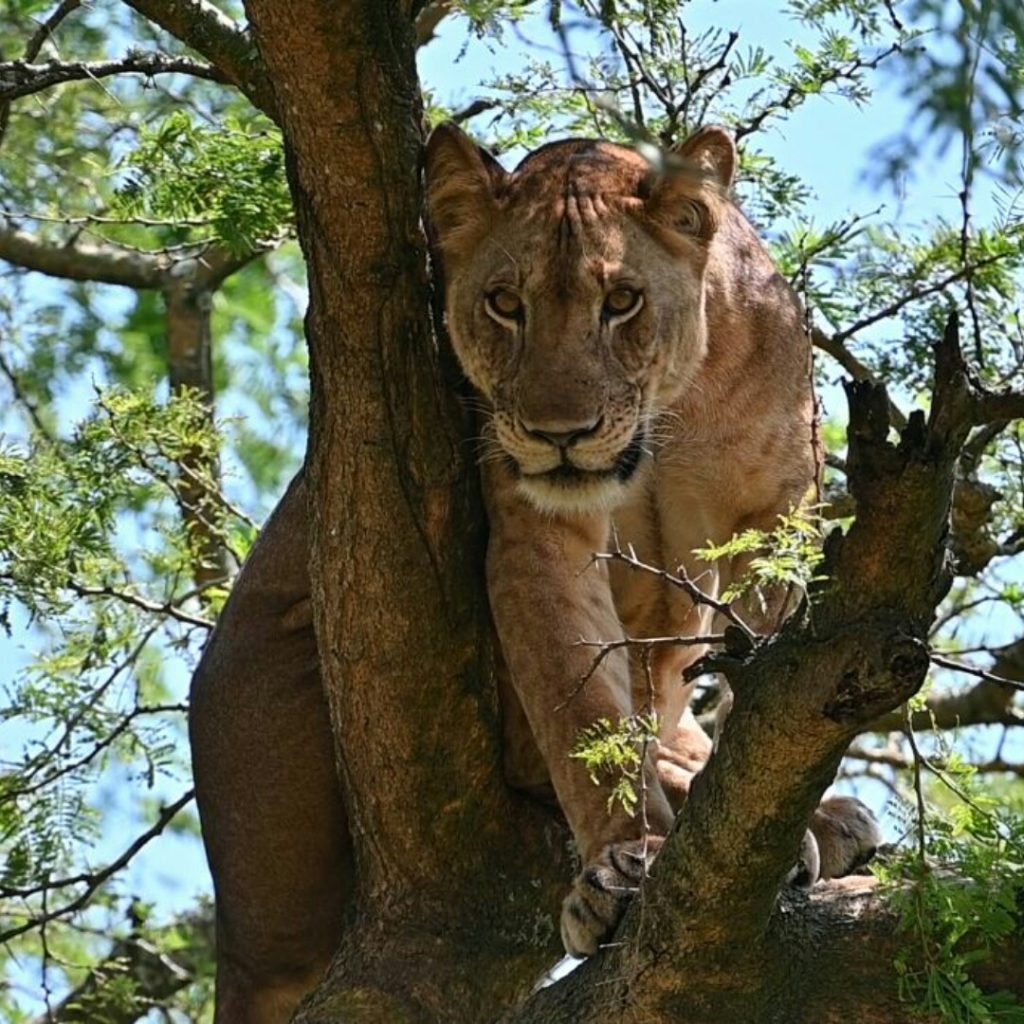
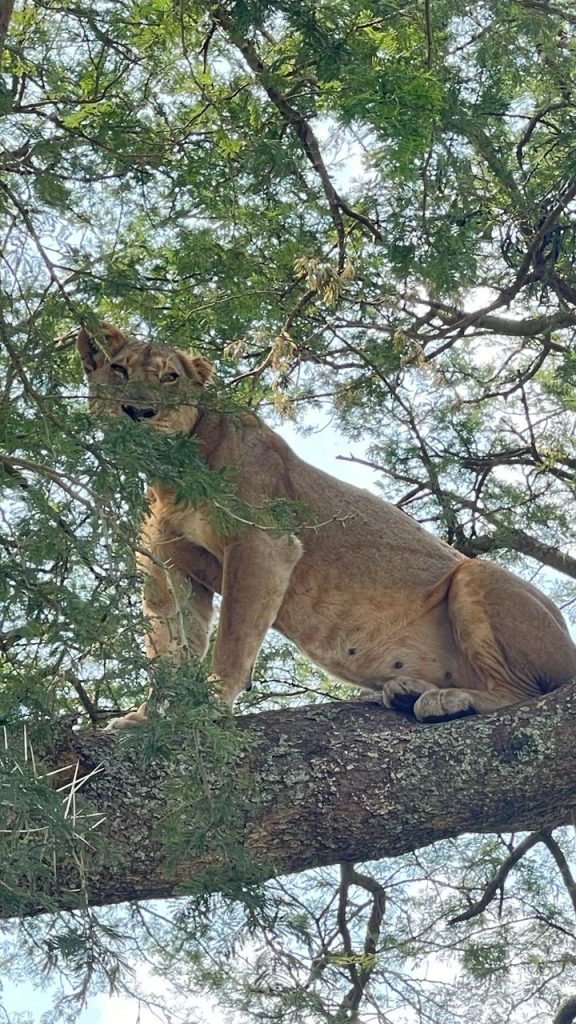
Unlike leopards, lions are not natural climbers. Across most of Africa, you will never find a lion more than a few feet off the ground. But in Ishasha, and in very few other places on earth, certain prides have developed the unusual and captivating habit of lounging high in the branches of giant fig and acacia trees.
Researchers and wildlife experts suggest several compelling reasons:
1. Escaping the Equatorial Heat
Straddling the equator, Uganda experiences relatively stable temperatures year-round with little seasonal variation. The hottest months (December, January, February, and again June, July, and August) see daytime temperatures range between 24°C and 34°C (75°F–93°F). On the open savannah, this heat is relentless and inescapable at ground level.
The elevated branches of Ishasha’s giant sycamore fig trees offer something precious: a cooling breeze. By climbing up, the lions remove themselves from the radiating heat of the ground and catch airflow that simply doesn’t exist at grassland level. It is nature’s air conditioning, and the Ishasha lions have learned to use it expertly.
For safari visitors, this dynamic works in their favour. The best time to spot tree-climbing lions in Ishasha is during the dry season midday hours, typically between 10am and 3pm, when the heat drives the prides upward.
2. Avoiding Biting Insects
The grasslands of Ishasha are home to swarms of biting flies and ticks, a genuine nuisance that lions are not immune to. During the dry months especially, these insects intensify significantly at ground level. Combined with the searing heat, the trees become a double refuge: cooler and insect-free. The lions simply climb above the problem.
3. A Strategic Vantage Point for Hunting
From a perch several metres above the ground, lions gain an unobstructed view across the vast Ishasha plains. This elevated vantage point allows them to spot herds of Uganda Kob, Topi, and other prey animals at much greater distances than would be possible from the ground. It is a tactical advantage that may have been one of the earliest reasons this behaviour developed, and one that has since become part of the pride’s inherited tradition.
4. Learned Behaviour Passed Through Generations
Perhaps most fascinatingly, tree-climbing in Ishasha appears to be a culturally transmitted behaviour, learned and passed down within specific lion prides rather than a universal lion instinct. Cubs observe adult lions climbing and follow suit, embedding the habit into the pride’s identity across generations. This is what makes the Ishasha lions not just a wildlife spectacle, but a genuine behavioural phenomenon worthy of scientific attention.
Whatever the combination of reasons, the sight of a 180-kilogram (400-pound) lion draped languidly across a high branch, tail swinging and gaze half-lidded in the heat, is wholly unforgettable.
How Rare Is Tree Climbing Lion Behaviour?
Tree-climbing lions are documented in only two places in Africa with any consistency: Ishasha in Uganda’s Queen Elizabeth National Park, and Lake Manyara National Park in Tanzania. Occasional sightings have been reported in other locations, but nowhere is it as regular or as reliably observed as in Ishasha.
This extreme rarity is what makes the Ishasha sector a must-visit destination for any serious safari enthusiast. Finding a lion in a tree is a genuinely scarce privilege, far rarer than a standard lion sighting, which is remarkable in itself but achievable across many African parks. The behaviour is not guaranteed on every game drive, and that unpredictability is part of what makes the encounter so electric when it happens.
A Distinctive Pride: The Black-Maned Lions of Ishasha
The Ishasha lion prides are not only unusual in their behaviour but visually distinctive as well. The male lions of this region are notably darker than many of their counterparts elsewhere, with deep, dark manes that can appear almost black. This striking physical characteristic, combined with their arboreal habits, makes Ishasha’s lions one of the most recognisable and remarkable lion populations anywhere on the continent.
The Ishasha Safari Experience
Visiting Ishasha feels profoundly different from the busier northern areas of Queen Elizabeth National Park. There are no crowds here. Game drives are intimate affairs, often with just your vehicle and the landscape, giving the experience the quality of genuine exploration rather than tourism.
The open plains are dotted with the broad, spreading canopies of giant sycamore fig trees (nature’s own “lion lounges”), and the sense that something extraordinary might be waiting in the next grove is constant and delicious. When your guide spots a tail dangling from a branch and the shape of a massive head emerges from the foliage above, the silence in the vehicle is absolute.
For those lucky enough to witness it, a tree-climbing lion sighting in Ishasha is consistently described as one of the defining moments of an African safari, a memory that outlasts all others.
Best Time to Visit Ishasha for Tree Climbing Lions
- Best overall season: The dry seasons (December to February and June to August) offer the highest probability of tree-climbing sightings, as heat and insects drive the lions upward.
- Best time of day: Midday game drives (10am–3pm) are most productive for tree-climbing sightings, when temperatures peak and the lions seek the shade and breeze of the upper branches.
- Wet season: While game drives are still possible and rewarding during the wet seasons (March to May and September to November), the lions are less likely to climb as temperatures are lower and insects fewer.
Where to Stay: Ishasha Wilderness Camp
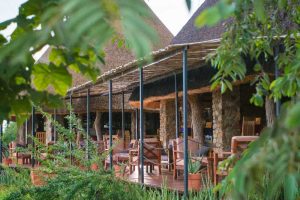
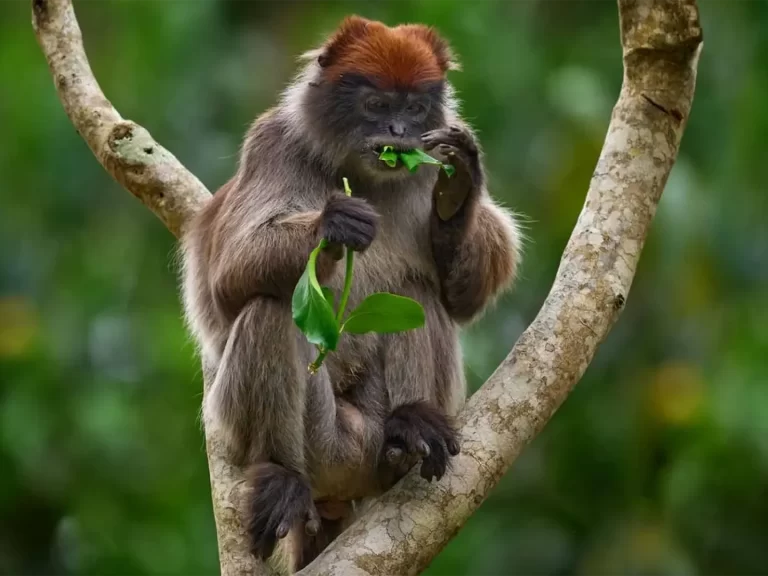
For travellers who can spare a night or two in Ishasha (and if budget allows, this is strongly recommended), Ishasha Wilderness Camp offers a genuinely exceptional base. Positioned on the banks of the Ntungwe River, the camp combines luxurious comfort with deep immersion in the bush. Elephants and buffalo pass through the camp’s perimeter, and primates are a constant presence in the riverine forest. The atmosphere is remote, quiet, and alive in exactly the way a true wilderness lodge should be.
Staying overnight dramatically increases your chances of multiple game drives and, with them, multiple opportunities to find the lions at their arboreal best.
Beyond the Lions: Other Wildlife in Ishasha
The Ishasha sector of Queen Elizabeth National Park is a rich wildlife destination in its own right. A typical game drive may yield sightings of:
- Elephants, often encountered in large herds moving through the savannah
- African Buffalo, common and frequently seen in substantial numbers
- Leopard, present in the riverine forest though always elusive
- Uganda Kob, the graceful national antelope of Uganda, abundant in Ishasha
- Topi, distinctive and photogenic antelopes with rich chestnut colouring
- Waterbuck, Warthog, and Hippopotamus
- Crocodiles along the Ishasha and Ntungwe rivers
Bird watching in Ishasha
For bird watching safari enthusiasts, Ishasha and the surrounding riparian forest along the Ishasha River (which also marks the border with the Democratic Republic of Congo) deliver remarkable avian diversity. Notable species include:
- Long-crested Eagle and Martial Eagle
- African Crake and African Green Pigeon
- Ross’s Turaco
- Senegal Plover and Grey Woodpecker
- Black Coucal and Striped Kingfisher
- Various weavers, sunbirds, and kingfishers along the river
The forest edge habitat, the open grasslands, and the river corridor combine to create a birding environment of exceptional variety, making Ishasha a rewarding stop even for travellers whose primary focus is mammals.
How to Get to Ishasha
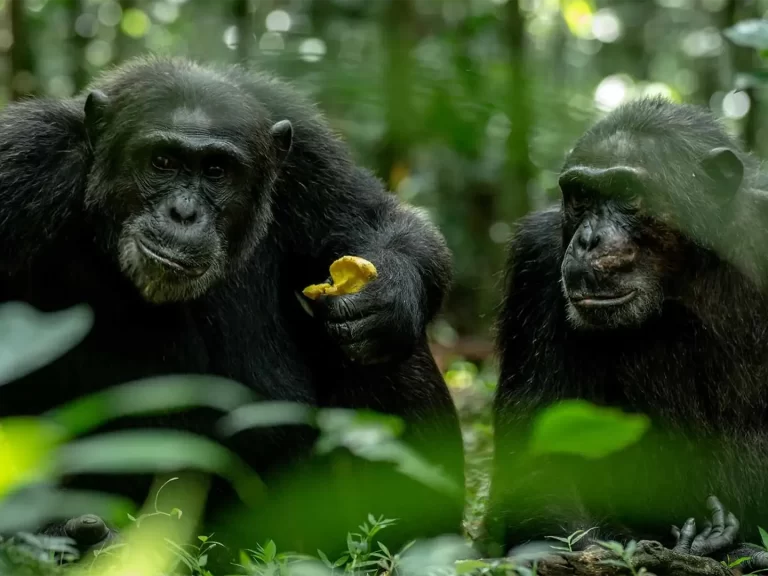
Ishasha lies approximately 480 kilometres (300 miles) from Kampala, typically a 6 to 7 hour drive via the Mbarara–Kasese highway. Most visitors combine Ishasha with the broader Queen Elizabeth National Park circuit, which also includes the Kazinga Channel boat cruise (famous for hippos, elephants, and waterbirds), the Kyambura Gorge (home to habituated chimpanzees), and the Kasenyi Plains in the north (excellent for lions on the ground and large mammal herds).
Ishasha also sits conveniently on the route between Bwindi Impenetrable National Park and the rest of Queen Elizabeth, making it a natural addition for travellers combining gorilla trekking with a broader Uganda wildlife safari.
Ishasha Is Where Lions Rewrite the Rules
Uganda’s safari story is often told through mountain gorillas and the Big Five. But the tree-climbing lions of Ishasha add a chapter that is both rare and magical, a story found almost nowhere else on Earth.
For travellers seeking a safari experience that genuinely surprises and challenges assumptions about what wild animals do and where they do it, Ishasha is where the savannah meets the treetops. It is where a pride of lions, black-maned and ancient in their habits, have quietly developed one of nature’s great curiosities, and where every midday game drive carries the electric possibility of looking up and finding one watching you back.
Planning a Uganda safari? Contact us to build a custom itinerary that includes the tree-climbing lions of Ishasha, gorilla trekking in Bwindi, and the best of Queen Elizabeth National Park.